How Rewire actually works
Most behavior change apps are streak counters with a wellness aesthetic. Rewire’s core systems, the Dopamine Score, the urge intervention flow, the Detox Challenge and the rewards, are each designed around specific findings from behavioral neuroscience and clinical psychology. This page documents what that research is, what it actually says, and how it shapes the app you see on your screen.
If you are a researcher, a clinician, a journalist, or a curious user who wants to verify the claims, this is the document for you.
The core thesis
Habit change is a learning process, not a willpower problem. Three findings shape everything in Rewire.
- 1
Habits run on context
Once a behavior is automatic, cues like a place, a time or a feeling trigger it more than intention does (Wood & Rünger, 2016). So Rewire acts at the cue: the urge.
- 2
Dopamine is about wanting
Dopamine neurons respond to expected rewards and to rewards that beat expectations (Schultz, 2016). The pull before you open an app is the moment to act on.
- 3
Change takes months
New habits took a median of 66 days to become automatic, with a range of 18 to 254 (Lally et al., 2010). Early motivation fades long before that.
That is why Rewire is built for the long middle of a habit change: a daily streak that counts showing up and does not reset when you slip, challenges with lives, and accountability partners.
The science behind each Rewire system
1. The Dopamine Score (quantified behavioral metric)
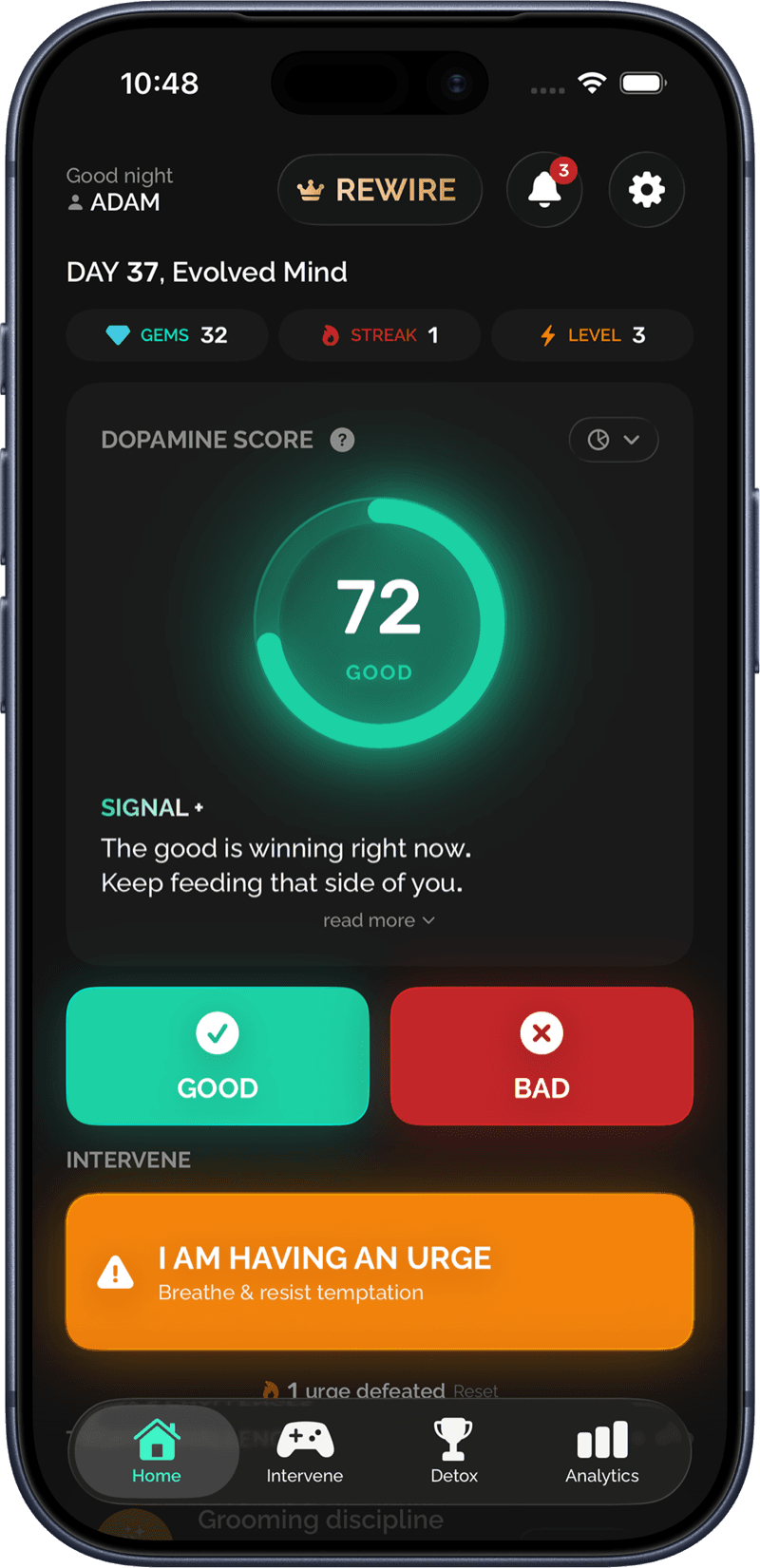
The Dopamine Score is a 0 to 100 number built from what you log. It is not a wellness score and not a productivity score. It summarises the balance of your logged behavior: how often you choose the habit you are building over the one you are breaking, and how long you have held that line.
| Part | Points | What feeds it |
|---|---|---|
| Habits | 0 to 40 | Share of good versus bad actions over the last 7 days, weighted by effort |
| Momentum | 0 to 30 | Your last 10 actions, with a bonus or penalty for runs |
| Recovery | 0 to 30 | Clean days since your last slip (up to 15), plus what you logged in the last 24 hours |
| Quick Action boost | up to +40 | +22 for a finished Quick Action, fading over 24 hours |
| Win bonus | 0 to 10 | Consecutive wins |
| Unlock penalty | -20 | For 30 minutes after you unlock apps the blocker is holding |
The total is kept between 0 and 100 and shown in five bands:
- Critical0 to 19
- Low20 to 39
- Neutral40 to 59
- Good60 to 79
- Optimal80 to 100
The research
Volkow, N. D., et al. (2011). Addiction: beyond dopamine reward circuitry. PNAS.
Nora Volkow’s work on drug addiction found lower dopamine D2 receptor availability in people with addiction, linked to low motivation and a muted response to everyday rewards. Whether phones and short-form video cause the same changes is still an open research question. The Dopamine Score does not measure brain chemistry. It is a behavioral proxy that makes your day-to-day pattern visible, so you can see it moving.
Schultz, W. (2016). Dopamine reward prediction error coding. Dialogues in Clinical Neuroscience.
Wolfram Schultz’s prediction-error work shows that dopamine neurons respond to the anticipation of reward, not only the reward itself. That is why Rewire puts its main tool at the moment of anticipation: the urge button, pressed when you feel the pull, before the app opens.
2. The Habit Loop (cue, routine, reward)
Rewire’s core cycle is short: log an action, watch the score change, earn or lose XP, and read SIGNAL, the feedback written from your own logs. It is built on the cue, routine, reward framework from habit research.
The research
Duhigg, C. (2012). The Power of Habit. Random House.
Duhigg’s book popularised the three-part loop of cue, routine and reward, drawing on habit research from MIT. In Rewire, the urge is the cue, the intervention or alternative action is the routine, and the change in your score and SIGNAL feedback is the reward.
Wood, W., & Rünger, D. (2016). Psychology of Habit. Annual Review of Psychology, 67.
Wendy Wood’s research shows that habits run on context-dependent automaticity, not conscious motivation, and that lasting change means changing cues and context, not just goals. It is the reason Predictive Urges is next on the roadmap: using SIGNAL data to spot the contexts where your urges start, so Rewire can step in earlier.
Lally, P., et al. (2010). How are habits formed. European Journal of Social Psychology, 40(6).
Lally’s UCL study found that habit formation took a median of 66 days, with wide variation (18 to 254 days). So Rewire does not treat a habit as done at day 21 or day 30. The Recovery part of the score keeps rewarding clean days, and your streak keeps running after any challenge ends.
3. The Urge Intervention System
When you tap “I AM HAVING AN URGE”, you go through a short, fixed pathway:
- 1Pick the habit
- 2Rate how strong it is
- 3Breathe for 15 seconds
- 4Choose 1 of 2 interventions
- 5Log I resisted or I gave in
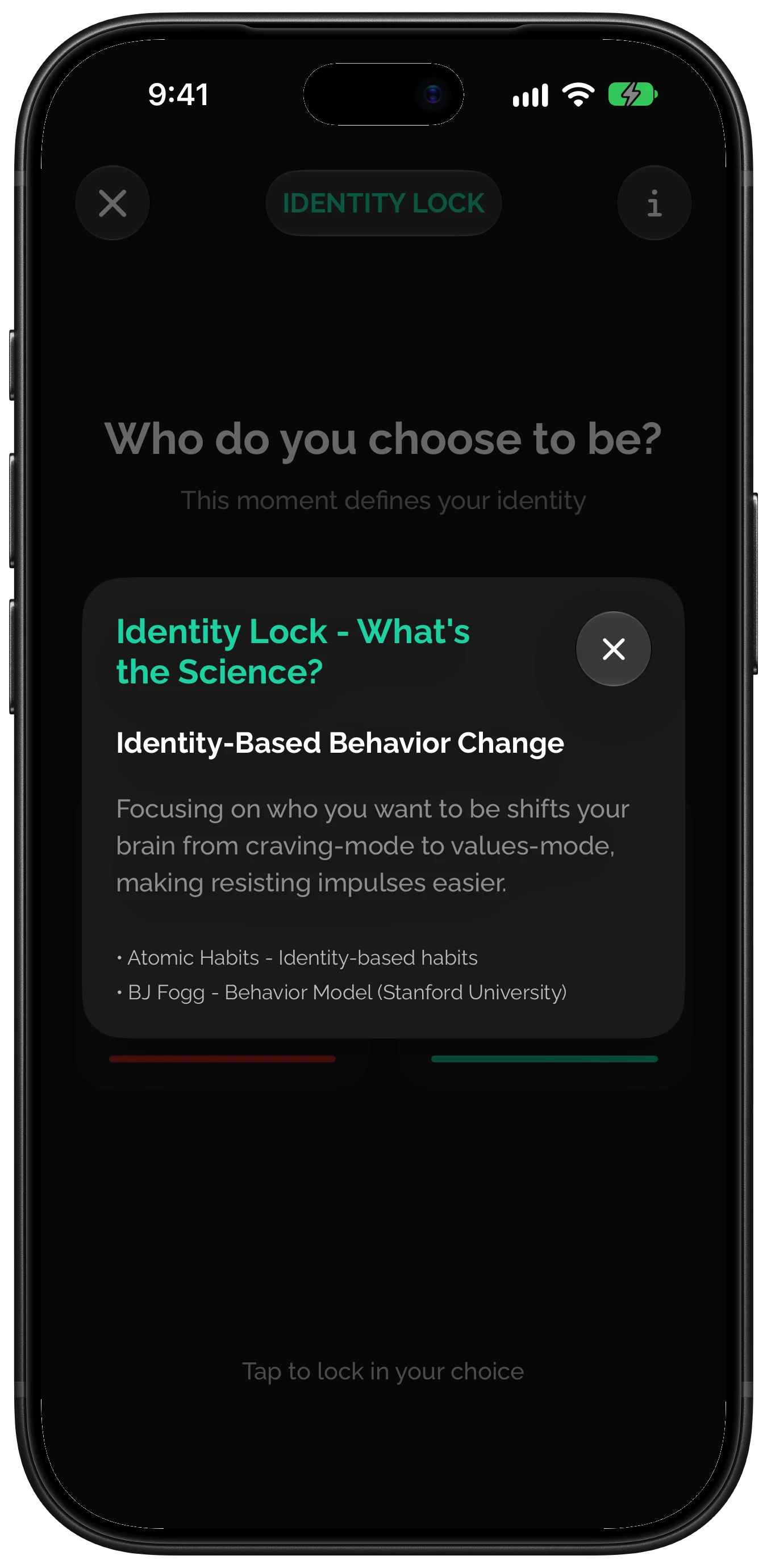
The library has twelve interventions, each between one and five minutes long. Four are documented against a specific clinical protocol below. The others build on the same principles: interrupting the automatic response, redirecting attention, and connecting the moment to who you want to be. Each one has a “What’s the Science?” panel in the app, and all 12 are explained step by step here.
- Pattern BreakPhysical actions to interrupt5 minFree
- Identity LockChoose who you want to be1 minFree
- Grounding ResetPhysical grounding with motion3 minFree
- Future MessageWould future you be proud?2 minFree
- Urge SurfingRide the wave without giving in3 minPro
- Reflex OverrideTrain your stop reflex2 minPro
- Face CalmRelease facial tension2 minPro
- Pressure ReleasePress, hold, release the urge3 minPro
- Trigger JournalIdentify patterns in urges3 minPro
- Values AnchorRemember what truly matters2 minPro
- Future LetterMessage from future self4 minPro
- Mind ShiftPuzzle away the craving2 minPro
The research
Reflex Override is built on inhibitory control training, where you practise stopping a response on cue. Studies of this protocol report effects on alcohol consumption, snacking, and impulsive behavior. Rewire turns the lab task into a two-minute mobile exercise.
Marlatt, G. A., & Donovan, D. M. (2005). Relapse Prevention (2nd ed.). Guilford Press.
Urge Surfing comes from Alan Marlatt’s mindfulness-based relapse prevention: watch the craving rise, peak and fade like a wave without acting on it. Rewire’s version is a wave you trace with your finger, so you feel the rise and fall during the urge itself.
Face Calm combines facial feedback with muscle relaxation. This multi-lab study found that facial posture has a small but reliable effect on emotional state.
Jacobson, E. (1938). Progressive Relaxation. University of Chicago Press.
Pressure Release uses Jacobson’s progressive muscle relaxation together with the TIPP skills (temperature, intense exercise, paced breathing, paired muscle relaxation) from dialectical behavior therapy. Progressive muscle relaxation has decades of clinical use behind it.
4. The Detox Challenge (lives and milestones)
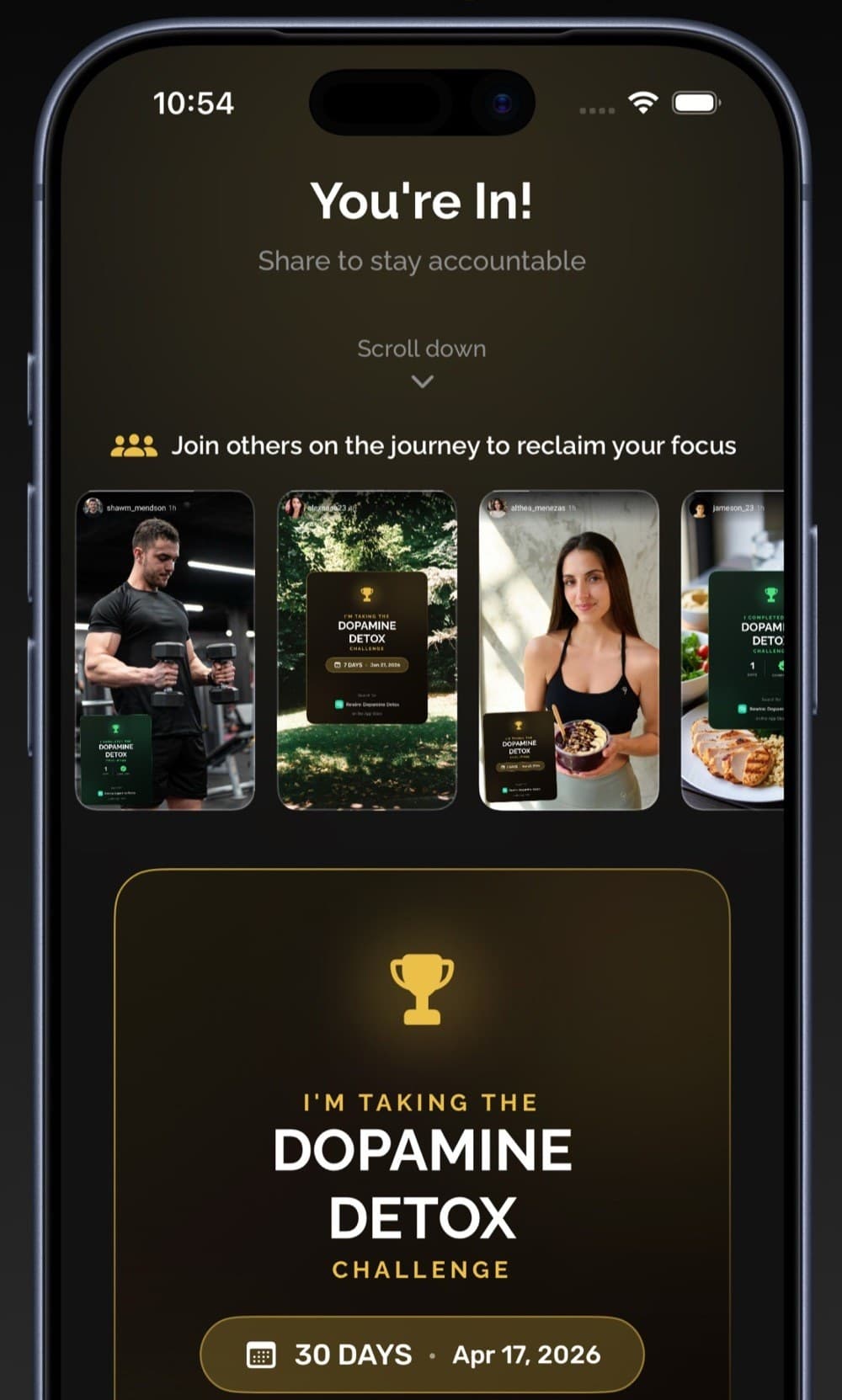
The Detox Challenge is a fixed commitment with a finish line. It is free for everyone. You start with three lives, and each slip costs one. Gems are banked at milestones along the way.
| Challenge | Length | Gems on finish | Milestones |
|---|---|---|---|
| Quick Reset | 24 hours | 100 | None |
| Week Reset | 7 days | 450 | +30 gems on day 3 |
| Full Reset | 30 days | 800 | +50 gems on days 7, 14 and 21 |
The research
Marlatt, G. A., & Donovan, D. M. (2005). Relapse Prevention (2nd ed.). Guilford Press.
Relapse-prevention research describes the abstinence violation effect: after one lapse, people often decide the whole attempt has failed and give up entirely. Lives and banked milestones work against that, so a single slip costs one life instead of the whole challenge.
5. Variable Reward and the Gems Economy
Every good habit and every resisted urge earns a random number of gems, and the range grows with effort. The variable amount is deliberate.
- 1 to 4Gems per good action, by effort
- 3xMultiplier with Pro
- 2 to 5Gems per photo challenge
- 100Daily cap on earned gems
Gems unlock sticker packs for your accountability partner chat.
The research
Ferster, C. B., & Skinner, B. F. (1957). Schedules of Reinforcement. Appleton-Century-Crofts.
Variable-ratio reinforcement produces the most persistent behavior and the slowest extinction. It is the same mechanism slot machines and social feeds use. Rewire points it at the actions you chose to build, never at time spent in the app, and caps it per day.
6. Identity-Based Behavior Change
The urge screen asks you to “Choose who you want to be” and tells you “This moment defines your identity” before you log I resisted or I gave in. One of the free interventions, Identity Lock, is built around the same question.
The research
Clear, J. (2018). Atomic Habits. Avery.
Clear’s synthesis argues that behavior change lasts when it is tied to a shift in self-concept rather than an outcome goal, drawing on identity theory in sociology and the self-perception tradition from Daryl Bem.
Bem, D. J. (1972). Self-perception theory. Advances in Experimental Social Psychology, 6.
Bem proposed that people infer their attitudes from watching their own behavior. Rewire shows each defeated urge back to you, for example in the urges defeated count on the home screen, as evidence of who you are becoming.
Privacy as methodological commitment
Your habit log, urges and score history are stored on your phone, and the core app needs no account. Some data does leave the device: product analytics, opt-in session recordings, an optional iCloud backup for Pro users on iPhone, and features like accountability partners, coach groups, support chat and the feedback survey, which run through Rewire’s servers. We do not sell data.
The principle behind this is methodological, not marketing. Behavioral data is the most intimate data a person generates, and collecting more of it creates pressure to optimize for engagement instead of outcomes. Rewire keeps as much as the features allow on your phone, and is built for you getting better, even if that means using the app less over time. See the full privacy policy for the technical breakdown.
References
- 1Bem, D. J. (1972). Self-perception theory. Advances in Experimental Social Psychology, 6, 1 to 62. doi:10.1016/S0065-2601(08)60024-6
- 2Clear, J. (2018). Atomic Habits. Avery.
- 3Coles, N. A., et al. (2022). A multi-lab test of the facial feedback hypothesis. Nature Human Behaviour, 6, 1731 to 1742. doi:10.1038/s41562-022-01458-9
- 4Duhigg, C. (2012). The Power of Habit. Random House.
- 5Ferster, C. B., & Skinner, B. F. (1957). Schedules of Reinforcement. Appleton-Century-Crofts.
- 6Jacobson, E. (1938). Progressive Relaxation. University of Chicago Press.
- 7Lally, P., van Jaarsveld, C. H. M., Potts, H. W. W., & Wardle, J. (2010). How are habits formed: Modelling habit formation in the real world. European Journal of Social Psychology, 40(6), 998 to 1009. doi:10.1002/ejsp.674
- 8Marlatt, G. A., & Donovan, D. M. (2005). Relapse Prevention: Maintenance Strategies in the Treatment of Addictive Behaviors (2nd ed.). Guilford Press.
- 9Schultz, W. (2016). Dopamine reward prediction error coding. Dialogues in Clinical Neuroscience, 18(1), 23 to 32. doi:10.31887/DCNS.2016.18.1/wschultz
- 10Verbruggen, F., & Logan, G. D. (2008). Response inhibition in the stop-signal paradigm. Trends in Cognitive Sciences, 12(11), 418 to 424. doi:10.1016/j.tics.2008.07.005
- 11Volkow, N. D., Wang, G. J., Fowler, J. S., Tomasi, D., & Telang, F. (2011). Addiction: beyond dopamine reward circuitry. PNAS, 108(37), 15037 to 15042. doi:10.1073/pnas.1010654108
- 12Wood, W., & Rünger, D. (2016). Psychology of Habit. Annual Review of Psychology, 67, 289 to 314. doi:10.1146/annurev-psych-122414-033417
Have a paper that should be on this list, or a critique of how Rewire interprets the research? Email connect@rewirelabs.app. This page is a living document and is updated as the science and the app change.
Download Rewire
Free on iPhone and Android. See the research at work on your own habits.